
Best Fencing for Active Dogs: Types & Installation
Table of Contents
- Why Active Dogs Need Specialized Fencing
- Chain-Link Fence for Dogs: Durability and Visibility
- Vinyl Fence for Dogs: Low Maintenance and Privacy
- Wood Fencing: Privacy and Aesthetic Appeal
- Fence Height for Dogs That Jump
- Preventing Digging Under the Fence
- Installation, Local Requirements, and Professional Service
- Comparison Table: Fence Types for Active Dogs
- Frequently Asked Questions
Last Updated: October 12, 2026
Why Active Dogs Need Specialized Fencing
Active dogs demand specialized solutions, and fencing for active dogs must be more than a typical pet enclosure.
The best fencing for active dogs isn't just about height or material, it's about how your dog thinks.
This guide covers the fence types that hold active dogs, the features that prevent escapes, and the installation details that separate a lasting fence from an expensive disappointment.
Chain-Link Fence for Dogs: Durability and Visibility
Chain-link remains the most practical choice for active dogs needing containment without privacy. It resists damage from jumping, pawing, and climbing far better than vinyl, and it's transparent, you can see your dog at all times, and your dog can see the yard beyond.
Chain-link's real advantage is durability under stress. A 200-pound dog throwing itself against a fence repeatedly will dent vinyl, crack wood, and bend aluminum; chain-link absorbs that impact without permanent damage.
Mesh Size and Height Specifications
Mesh opening size is critical. Standard residential chain-link uses 1.25-inch or 1.5-inch openings, fine for medium and large dogs, but small dogs can squeeze through or get their heads stuck.
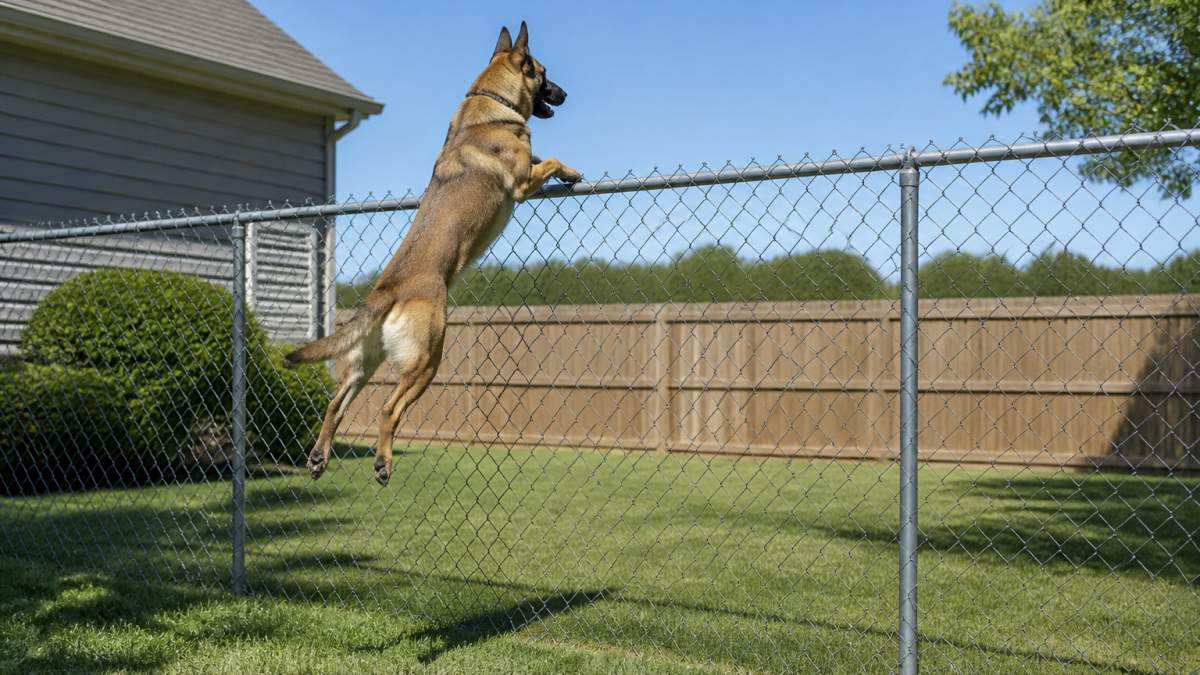
Height matters more for jumping dogs. A 4-foot fence contains most dogs under 30 pounds; active medium dogs (30-60 pounds) need 5 feet; large, athletic breeds or confirmed jumpers need 6 feet minimum.
Escape Prevention Features
Active dogs often dig. Chain-link alone doesn't stop this. The fence needs a below-ground barrier: either an L-shaped footer that bends outward at the base, or a solid barrier buried 12-18 inches deep along the interior perimeter.
Some contractors skip this to cut costs, don't let yours. A digging dog will find the gap under a standard fence within weeks.
Vinyl Fence for Dogs: Low Maintenance and Privacy
Vinyl fencing appeals to homeowners who want a clean, low-maintenance look and privacy over visibility.
Vinyl is softer than chain-link and dents or cracks under repeated impact from jumping or pawing.
The privacy benefit is genuine: your dog can't see passing dogs, people, or animals that trigger reactive behavior, which reduces fence-line aggression and escape attempts.
Design Considerations for Jumping and Climbing
If you choose vinyl for an active dog, commit to height: vinyl typically starts at 4 feet, so specify 6 feet minimum for any dog with jumping ability.
Vinyl also needs a sturdy framework. Panels are heavier than they look, and a dog repeatedly jumping or running the fence line stresses posts and rails. Ensure your contractor uses concrete footings for every post, not surface-mounted brackets.
Wood Fencing: Privacy and Aesthetic Appeal
Wood fencing is the premium choice for privacy and curb appeal, but the worst material for active dogs on durability.
If you choose wood for an active dog, accept constant maintenance: regular staining or sealing to prevent rot, repairs for chewed or warped boards, and eventual full replacement sooner than other materials.
The solid surface also works like vinyl: it reduces visibility and can help with reactive dogs. But the durability trade-off is steep.
Fence Height for Dogs That Jump
Height is the most common reason an active dog gets out, and the most common reason owners overpay for a fence that still fails. The right height isn't a breed lookup; it's a measurement of your dog's actual vertical and the behavior driving the jump.
Measure the dog, not the breed
Watch your dog jump in an open yard with no fence to distract it. Have someone hold a treat or toy at increasing heights and note the highest point the dog's rear paws leave the ground. That number, not the breed standard, sets your floor. Then add a buffer:
- Casual jumper (clears under 3 feet): a 4-foot fence is usually enough, but only if the dog is not also a climber.
- Athletic jumper (clears 3-4 feet): go to 5 feet minimum. This covers most Labs, Golden Retrievers, and similar builds.
- Serious jumper (clears 4-5 feet): 6 feet is the practical minimum, and 6 feet with a top rail or lean-in is safer.
Rule of thumb: build the fence 12-18 inches taller than your dog's measured maximum jump. A dog that jumps 4.5 feet will eventually learn the approach angle and clear a 5-foot fence, so the buffer isn't optional.
Why the escape behavior changes the height math
Jumping is rarely the whole story. A dog that jumps because it sees something on the other side (prey drive, fence-line reactivity) will keep trying even after you raise the fence, because the trigger is still visible, height alone is a losing game; you must also block the sightline.
That's why height must be paired with behavior. A 6-foot chain-link fence stops a casual jumper cold but does almost nothing for a dog jumping because it is panicked and alone.
Height, visibility, and the trade-off nobody mentions
Tall solid fences (wood, vinyl) block the trigger and reduce jumping driven by external stimuli. Tall see-through fences (chain-link, hog wire) let the dog watch the trigger, which can increase fence-line running and jumping in reactive dogs.
What height does not fix
A taller fence doesn't stop digging, and it doesn't stop climbing on a fence with horizontal footholds. If your dog both jumps and digs, raising the fence without a below-ground barrier just moves the escape route. Treat height, digging prevention, and anti-climb design as one system, not three separate upgrades.
Preventing Digging Under the Fence
Digging is the most common escape method for active dogs. A dog that panics, has high prey drive, or simply gets bored will excavate under a fence in hours.
The standard solution is a below-ground barrier installed during construction. An L-shaped footer bends outward 12 inches underground and curves upward along the interior perimeter, forcing a digging dog to hit the barrier before it can tunnel under the fence line.
Below-Ground Barriers and Installation
Footer depth matters. Shallow 6-inch barriers are common but inadequate; 12-18 inches is the practical standard.
The interior curve is critical: the barrier must extend far enough into the yard that a dog digging straight down hits it before reaching the fence line.
Timing matters: this work happens during the initial fence build. Adding a barrier to an existing fence is possible but expensive, requiring excavation along the entire perimeter.
Installation, Local Requirements, and Professional Service
Installation is where most active-dog fences succeed or fail, and where the cost conversation lives. Two fences with identical materials can differ by thousands of dollars depending on footings, post spacing, below-ground barriers, and permitting.
What drives the installed cost
Fence pricing is usually quoted per linear foot, installed. The variables that move that number most for an active-dog fence are:
- Height. A 6-foot fence uses more material and deeper posts than a 4-foot fence, and the labor difference is real.
- Below-ground barrier. An L-footer or buried wire mesh adds material and excavation along the entire perimeter, the most-skipped line item by low bidders and the most important one for a digging dog.
- Footings. Concrete footings at every post, set below the frost line where applicable, cost more than surface-mounted brackets and last decades longer. A dog that slams into the fence repeatedly will expose every weak footing.
Because prices vary by region and season, get at least three itemized quotes and compare them line by line, not on the total. A quote that omits the below-ground barrier isn't cheaper; it's incomplete.
DIY versus professional installation
A confident homeowner can install chain-link or hog wire over a weekend on flat ground with no barrier. The moment the job includes a below-ground barrier, concrete footings, a slope, or a permit, the DIY math usually stops working.
If you DIY, the non-negotiables are: footings below the frost line, post spacing no wider than the manufacturer specifies, a below-ground barrier continuous around the entire perimeter (no gaps at corners or gates), and a gate latch the dog cannot nose open.
Local requirements you should verify before you dig
Rules vary by jurisdiction. The ones that most often affect an active-dog fence are:
- Height limits. Many residential zones cap front-yard fences at 3-4 feet and allow taller fences only in the backyard. If your dog needs 6 feet, that usually means a backyard fence.
- Setbacks. Fences often must sit a set distance inside the property line, which eats into the run space for active dogs.
- Easements and utility lines. Before any digging, call 811 to have underground utilities marked, free and required in most areas (811 Before You Dig). Digging into a gas or electric line is a safety emergency, not a paperwork problem.
What to ask a contractor before you sign
A short list of questions separates a contractor who builds active-dog fences from one who builds generic fences:
- How deep are the footings, and are they concrete at every post?
- What is the post spacing, and does it match the manufacturer's spec for this height?
- How is the below-ground barrier installed, and does it run continuously around corners and gates?
- Do you handle the permit and the 811 utility locate, or do I?
- What is the gate hardware, and is it self-latching?
- What is the workmanship warranty, and what does it actually cover?
A contractor who answers without hesitation is building for the dog, not just the property line. One who dodges the barrier question is why so many active-dog fences fail in year one.
Comparison Table: Fence Types for Active Dogs
| Fence Type | Best For | Height | Digging Prevention | Maintenance | Durability |
|---|---|---|---|---|---|
| Chain-Link | Most active dogs; visibility needed | 5-6 feet | Requires L-footer | Minimal; occasional cleaning | Excellent; resists impact |
| Vinyl | Privacy preference; low-maintenance desire | 5-6 feet | Requires solid barrier | Low; occasional cleaning | Fair; dents under impact |
| Wood | Privacy and aesthetics | 4-6 feet | Requires L-footer | High; regular staining/sealing | Poor; rots and warps |
Choosing the right fence for an active dog comes down to understanding your dog's specific escape methods and selecting materials that resist them. Chain-link with a proper below-ground barrier and adequate height contains most active dogs reliably.
At Fencementals, we install fences for active dogs across the Midlands. The ones that work share three things: they're tall enough for the dog's jumping ability, they have a below-ground barrier to prevent digging, and they're installed with solid workmanship that keeps them standing straight for years.
Frequently Asked Questions
What type of fence is best for an active dog?
The best fencing for active dogs depends on their behavior. Chain-link offers durability and visibility at a lower cost. Vinyl provides privacy and low maintenance. Wood delivers privacy and aesthetic appeal but requires more upkeep. For dogs that jump, a 5- to 6-foot height is standard. For diggers, add an underground barrier or L-shaped footer. Match the fence type to your dog's size, jumping ability, and digging habits.
How tall should a fence be for a dog that jumps?
Most active dogs require a fence at least 5 to 6 feet tall. Small to medium dogs may be contained by a 4-foot fence, but larger or athletic breeds often need 6 feet or taller. If your dog can clear 6 feet, consider a 7-foot fence or add angled extensions at the top. The goal is to eliminate the temptation to jump by making the effort impossible.
What fence is best for dogs that dig?
Chain-link and vinyl fences both work for diggers when paired with an underground barrier. Install an L-shaped footer buried 6 to 12 inches deep, extending outward 6 to 12 inches from the fence line. This prevents dogs from digging under and escaping. Professional installation ensures the barrier is correctly positioned and secured.
Is vinyl or wood fencing better for dogs?
Vinyl is better for low maintenance and durability. It resists chewing, rot, and weather damage, making it ideal for active dogs. Wood offers superior privacy and curb appeal but requires regular maintenance, staining, and repair. For active dogs that might chew or damage the fence, vinyl's durability often justifies the higher upfront cost. Wood works best for calmer dogs or when privacy is the priority.
Can active dogs climb chain-link fences?
Yes, some active dogs can climb chain-link fences, especially if the mesh is large enough to grip. Dogs with strong hind legs or climbing instincts may scale a chain-link fence. To prevent this, ensure the fence is at least 5 to 6 feet tall, use smaller mesh (1-inch or less), and eliminate any horizontal supports or objects near the fence that a dog could use to gain height. Consider adding a roller or angled extension at the top.