
Best Fence Materials for Dogs: A 2026 Guide
Table of Contents
- Choosing the Right Fence Material for Your Dog
- Wood vs. Vinyl Fence for Dogs: Durability and Maintenance Trade-offs
- Chain-Link Fence for Dogs: Affordability and Visibility
- Low-Maintenance Fence for Dogs: Materials That Last
- Fence to Keep Dogs from Digging: Ground-Level Solutions
- Height, Spacing, and Escape Prevention by Dog Size
- Installation, Retrofitting, and Common Failure Points
- Frequently Asked Questions
Last Updated: October 11, 2026
Choosing the Right Fence Material for Your Dog
Selecting the right fence materials for dogs means balancing durability, safety, and budget against your dog's size, temperament, and escape habits. A fence that works for a small, calm dog won't contain a large, athletic breed that digs or climbs. The best choice depends on matching material properties to your specific dog's behavior and your yard's conditions.
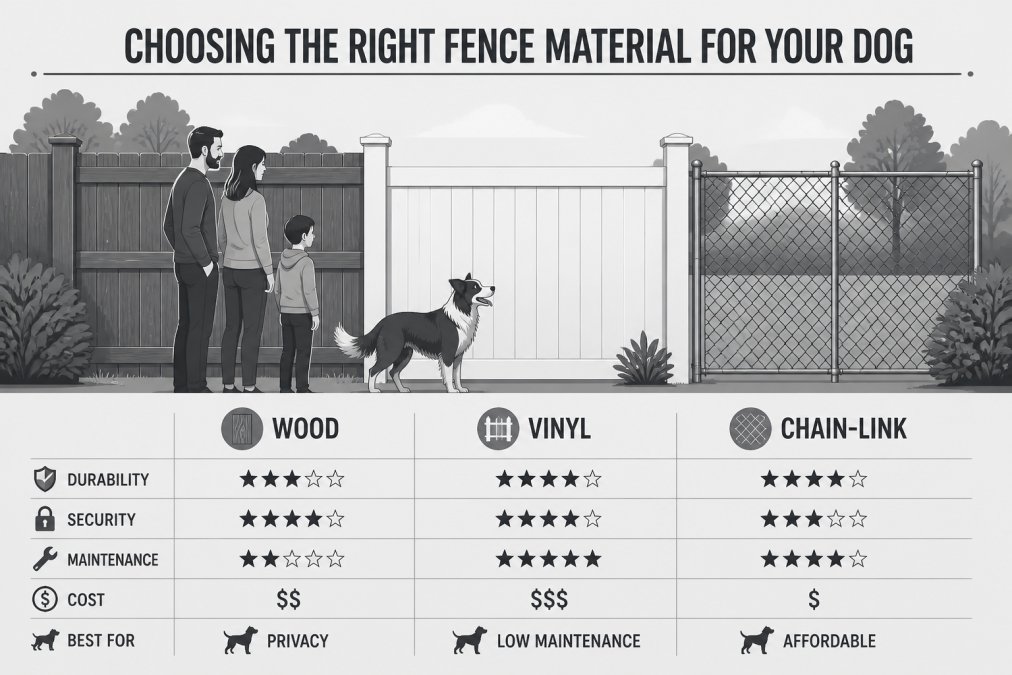
The fence material you choose affects maintenance costs, longevity, visibility, and escape prevention. Some materials excel at blocking climbing and digging; others withstand harsh weather better. Your job is to find the material that solves your actual problem, whether that's a digger, jumper, chewer, or a dog needing a secure perimeter.
Wood vs. Vinyl Fence for Dogs: Durability and Maintenance Trade-offs
Wood and vinyl represent opposite approaches to durability versus maintenance. Understanding lifecycle cost, not just upfront price, is essential for choosing between them.
When Wood Makes Sense
Wood fencing offers natural aesthetics and solid containment at lower upfront cost than vinyl, creating a physical barrier that blocks visibility and prevents most dogs from climbing.
Wood's main appeal is curb appeal and repairability, a single damaged board can be replaced without replacing the entire fence. For homeowners who prioritize appearance and accept regular maintenance, wood is viable.
Real maintenance burden: Wood absorbs moisture, swells, warps, and rots. In humid climates, soft spots develop within 5-7 years. You must seal or stain every 2-3 years to slow deterioration; skipping this shortens fence life to 8-10 years instead of 15-20.
Dog-specific hazards: Chewing dogs accelerate wood damage and risk splinter injuries. Wood is also vulnerable to termites and carpenter ants, which can cause structural failure within months. Digging dogs loosen posts as soil erodes, creating ground-level escape gaps.
Cost reality: Upfront cost is 30-40% less than vinyl, but total cost of ownership over 15 years often exceeds vinyl when factoring in sealing, staining, and repairs.
When Vinyl Is the Better Choice
Vinyl doesn't rot, splinter, or require staining. It resists moisture, UV damage, and pests, lasting 20-30 years with minimal maintenance.
For dogs, vinyl won't absorb water, splinter, or develop soft spots that chewers exploit. The smooth surface is harder for dogs to grip when climbing. Vinyl is immune to termites and carpenter ants.
Real maintenance burden: Vinyl requires only occasional washing. Over 20 years, this means dramatically lower labor and material costs than wood.
Dog-specific hazards: Vinyl's main limitation is visibility, privacy styles prevent dogs from monitoring territory, which can increase anxiety. Vinyl can become brittle below -20°F, rarely causing cracks from dog impact.
Cost reality: Vinyl costs 30-50% more upfront but lower maintenance and longer lifespan (20-30 years vs. 10-15) make total cost of ownership comparable or lower.
Decision Matrix: Wood vs. Vinyl
Choose wood if:
- You prioritize curb appeal and are willing to seal/stain every 2-3 years
- Your dog doesn't chew aggressively
- Your region has low humidity and minimal pest pressure
- You want lower upfront cost and can handle repairs
Choose vinyl if:
- You want minimal maintenance and long-term durability
- Your dog chews or you live in a humid, pest-prone region
- You plan to stay in your home 15+ years (vinyl's lifespan advantage becomes clear)
- You prefer not to refinish the fence regularly
- Your dog doesn't require visibility to outside distractions
Chain-Link Fence for Dogs: Affordability and Visibility
Chain-link is the most affordable fence material and offers complete visibility, appealing to homeowners who want to monitor their yard.
For dogs, chain-link has a critical limitation: it's easy to climb. Large, athletic dogs can scale it; small dogs can squeeze through larger mesh openings.
Mesh opening size matters significantly. Standard 2-inch diamonds allow small dogs to squeeze through; 1-inch or 1.25-inch mesh is safer but costs more.
Chain-link is vulnerable to chewing and digging. Metal rusts over time in humid or coastal areas, though galvanized and vinyl-coated options slow corrosion.
Chain-link works best for dogs that don't climb, dig aggressively, or escape-focus. It suits temporary fencing, rentals, or yards prioritizing visibility.
Low-Maintenance Fence for Dogs: Materials That Last
For low maintenance, vinyl and vinyl-coated chain-link resist rot, pests, and UV damage without sealing or staining.
Vinyl requires only occasional washing. Vinyl-coated chain-link combines affordability with better corrosion resistance than bare metal, though it won't last as long as solid vinyl.
Aluminum is low-maintenance and rust-free but softer than steel and can bend under impact, making it unsuitable for large dogs.
Wood maintenance increases significantly, even pressure-treated wood needs resealing every few years. High humidity, rain, or sun exposure makes wood maintenance a real commitment.
Fence to Keep Dogs from Digging: Ground-Level Solutions
Dogs that dig need ground-level barrier solutions, not just height.
The most effective solution is extending the fence below ground 6-12 inches, creating a barrier that discourages digging.
If burying isn't practical, install an L-shaped barrier extending 12-18 inches outward at ground level, forcing digging dogs deeper than most will attempt.
Alternatively, lay wire mesh or hardware cloth along the ground inside the fence. Dogs that dig will hit the wire and usually stop.
For chain-link, secure the bottom edge tightly to the ground or bury it. Ground-level gaps are escape routes for diggers.
Height, Spacing, and Escape Prevention by Dog Size
Fence height and gap size determine containment, but height alone doesn't guarantee it, you must account for your dog's jumping ability, motivation, and escape method.
Height Recommendations by Dog Size and Behavior
Small dogs (under 20 pounds):
- Minimum height: 3 feet for calm breeds; 4 feet if your dog shows jumping tendency or anxiety
- Spacing: Picket gaps no more than 4 inches; chain-link use 1-inch or 1.25-inch mesh to prevent slipping through
Medium dogs (20-60 pounds):
- Minimum height: 4 feet for calm breeds; 5 feet for athletic or escape-motivated dogs
- Spacing: Picket spacing 4 inches; chain-link standard 2-inch mesh is adequate
Large dogs (over 60 pounds):
- Minimum height: 5 feet for calm, non-athletic breeds
- Recommended height: 6 feet for athletic, anxious, or escape-motivated dogs
- Why: Some large breeds (German Shepherds, athletic mixed breeds, anxious dogs) can clear 5 feet, especially if they're motivated by something outside the fence. A 6-foot fence is the safest choice for high-energy or escape-prone large dogs. For dogs with a history of jumping fences, 6 feet is essential.
- Spacing: Picket spacing of 4 inches remains standard. For chain-link, standard 2-inch mesh is adequate.
Ground-Level Gaps: The Often-Overlooked Escape Route
The gaps at the bottom of the fence matter as much as height. Measure the clearance between the bottom of the fence and the ground. Anything larger than 2 inches creates a potential escape route for small dogs or a digging opportunity for any dog.
For small dogs: Gaps larger than 1 inch allow escape. Check your fence regularly, especially after heavy rain or in areas where soil has settled.
For medium and large dogs: Gaps larger than 2 inches allow escape or digging. For dogs that dig, eliminate ground-level gaps entirely by burying the fence 6-12 inches below the surface or installing an L-shaped ground barrier.
Behavior-Specific Adjustments
Your dog's individual behavior may require fence specifications beyond standard size-based recommendations.
Jumping dogs: If your dog has a history of jumping fences, add 1 foot to the standard height recommendation. A dog that clears a 4-foot fence at a neighbor's house needs a 5-foot fence at home. A dog that clears a 5-foot fence needs 6 feet.
Digging dogs: Height is irrelevant if your dog tunnels underneath. Extend the fence below ground 6-12 inches, or install an L-shaped barrier at ground level extending 12-18 inches outward. Without addressing the ground-level barrier, a tall fence won't contain a determined digger.
Climbing dogs: Rare, but some athletic dogs (particularly those with climbing experience or high prey drive) can climb chain-link or low-profile fences. If your dog shows climbing behavior, use solid fencing (wood or vinyl) rather than chain-link, and ensure height is at least 5-6 feet.
Escape-motivated dogs: Dogs with a history of escaping (from previous homes, shelters, or your current yard) need maximum containment. Use solid fencing (wood or vinyl) rather than chain-link, set height at 6 feet minimum, eliminate all ground-level gaps, secure gates with heavy-duty latches, and consider adding a second barrier (such as a crate or secondary enclosure) during unsupervised time.
Local Code and Neighbor Considerations
Before installing a fence, check your local zoning regulations. Many jurisdictions have maximum fence-height limits (typically 4-6 feet in residential areas). Some require setbacks from property lines. A few require permits or neighbor approval. Building a fence that violates local code can result in fines or forced removal, so verify requirements before construction.
If your dog needs a 6-foot fence but local code limits height to 4 feet, explore alternatives: solid fencing (which may be allowed at greater heights than chain-link in some jurisdictions), double-fencing on your side of the property line, or addressing the underlying escape behavior (training, exercise, environmental enrichment) to reduce the need for maximum height.
Installation, Retrofitting, and Common Failure Points
Installation quality determines how long your fence actually lasts and how well it contains your dog. Proper post depth, spacing, and alignment prevent sagging, leaning, and gaps that develop over time.
Posts should be set 2-3 feet deep for residential fences, depending on soil conditions. In sandy or loose soil, go deeper. In clay or rocky soil, 2 feet may be sufficient.
Common failure points include corners, gates, and ground-level sections. Corners experience lateral stress and often lean or warp first. Gates need heavy-duty hinges and latches because they're opened and closed repeatedly. Dogs also tend to test gates for weakness, so gate hardware must be secure.
Ground-level gaps develop as posts settle or soil erodes. Check your fence regularly for gaps at the bottom, especially after heavy rain or in areas where digging has occurred.
If you're retrofitting an existing fence, address specific failure points rather than replacing the entire fence. A leaning section might just need new posts. A gap at ground level might be fixed by extending the bottom edge or adding a ground barrier.
Choosing fence materials for dogs isn't just about picking the most durable option, it's about matching the material to your dog's behavior and your maintenance willingness. Wood offers aesthetics but requires ongoing care. Vinyl lasts longer with less work.
At Fencementals, we help homeowners in the Midlands select and install fence materials that actually contain their dogs and stand up to the elements. Whether you need a secure containment solution, a privacy fence, or repairs to an existing fence, we provide straightforward pricing and quality workmanship that lasts.
Frequently Asked Questions
What type of fence is the most durable for dogs?
Vinyl and aluminum fencing are the most durable for dogs because they resist chewing, weather damage, and rot. Vinyl won't splinter or absorb moisture, and aluminum won't rust or corrode. Wood fences are less durable in wet climates and require regular maintenance to prevent rot and insect damage. Chain-link is affordable but offers less privacy and can rust over time in humid environments. Your choice depends on your climate and your dog's chewing habits.
Is wood or vinyl fencing better for dogs?
Vinyl is generally better for dogs because it resists chewing, requires no staining or sealing, and lasts 20-30 years with minimal maintenance. Wood is more affordable upfront and offers better aesthetics and privacy, but requires regular staining and sealing to prevent rot, splinters, and insect damage. Dogs can also chew through wood more easily. Choose vinyl if you want low maintenance and durability; choose wood if budget and appearance are your priorities and you're willing to maintain it.
What fence material is best for a dog that digs?
No fence material alone stops digging; you need a ground-level barrier. Bury fence panels 6-12 inches deep, or install an L-shaped footer that extends outward. You can also add a dig barrier (landscape fabric, chicken wire, or rigid panels) along the base. Vinyl and aluminum are easier to retrofit with these barriers than wood. Combine the barrier with your preferred fence material for a secure perimeter that prevents escape through tunneling.
What type of fence has the least maintenance?
Vinyl and aluminum fences require the least maintenance, just occasional cleaning with a hose. They don't need staining, sealing, or regular repairs. Chain-link is low-maintenance but can rust and requires occasional cleaning. Wood requires annual or biennial staining and sealing, plus repairs for rot and insect damage. If you want to minimize upkeep, vinyl is the clear choice, though it costs more upfront than wood or chain-link.