
Fence Installation for Sloped Yards: A Step-by-Step Guide
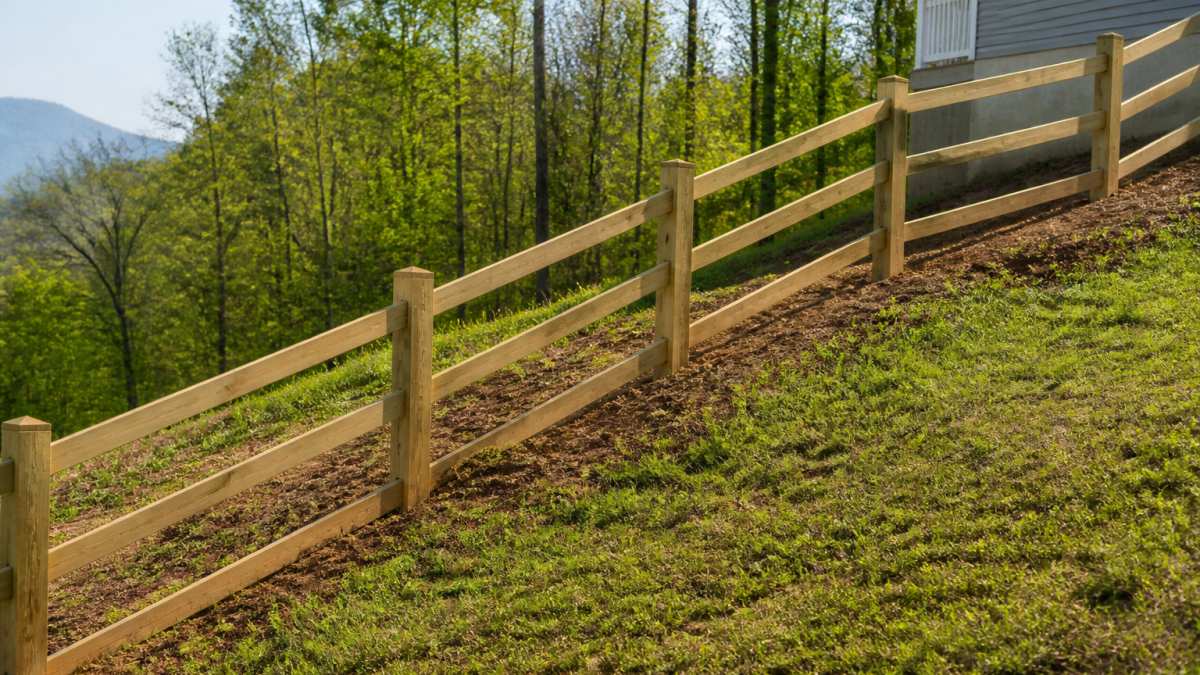
Table of Contents
- Understanding Racked vs. Stepped Fence Installation Methods
- How to Measure Slope and Grade for Your Fence
- Choosing the Right Material for Sloped Terrain
- Post Depth, Spacing, and Structural Stability on Slopes
- Managing Drainage and Erosion Control
- Avoiding Hidden Costs in Sloped Fence Installation
- Common Mistakes to Avoid When Installing on Slopes
- Frequently Asked Questions
Last Updated: September 28, 2026
Understanding Racked vs. Stepped Fence Installation Methods
When you're building a fence on sloped terrain, fence installation for sloped yards requires a fundamental choice: rack the fence to follow the slope, or step it in horizontal sections. This decision shapes everything that comes next, your material costs, labor time, structural stress points, and how the finished fence looks.
Racking means tilting the fence panels to follow the ground's angle, with top and bottom rails parallel to the slope. This creates shear stress at the rail-to-post connection points as panels twist to conform to the angle.
Stepping keeps panels vertical and level, dropping in sections where the slope changes. This eliminates shear stress because weight and wind load transfer straight down through posts, not at an angle.
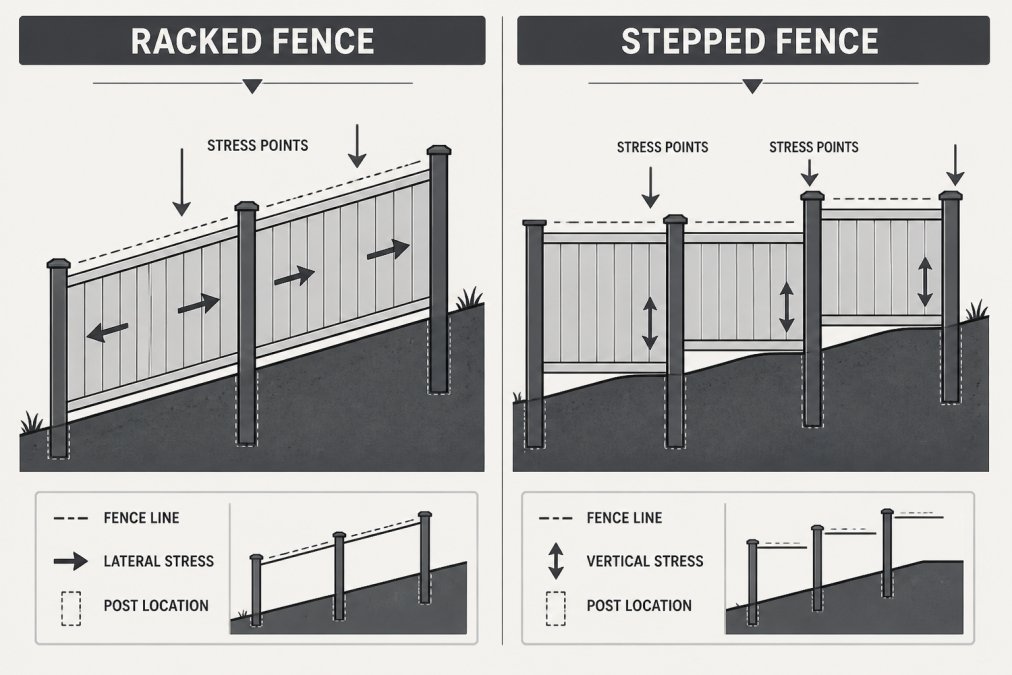
Material-specific limitations matter here. Vinyl panels are rigid and cannot flex under racking stress, attempting to rack vinyl on slopes steeper than 10 degrees risks cracking the panels or stressing the rail connections to failure. Wood panels bend slightly, which allows them to conform to racking without cracking, making wood the better choice for racking on moderate slopes. Aluminum panels fall between the two: they're stiffer than wood but more forgiving than vinyl. Chain link fabric stretches naturally, so it adapts to racking on any slope without structural risk.
Racking works best on gentle to moderate slopes under 15 degrees and installs faster. Stepped fences handle steep slopes better and are preferred for privacy screening.
Racking is faster but places continuous shear stress on panels. Stepping takes more time but each section experiences only vertical load. On slopes steeper than 20 degrees, stepped installation is the only viable option.
Your slope's angle and material choice together determine which method actually works:
- Gentle slopes under 10 degrees: Racking works easily with any material. Vinyl, wood, or chain link all perform well.
- Moderate slopes 10-15 degrees: Racking still works, but vinyl begins showing stress risk. Wood or chain link are safer choices. Stepping is also viable and may cost less in material waste.
- Moderate-to-steep slopes 15-20 degrees: Stepping becomes preferable. Racking is possible with wood or chain link but not recommended for vinyl without custom reinforcement.
- Steep slopes over 20 degrees: Stepping is necessary. Racking is structurally unsound and will fail within 2-5 years on most materials.
Wet, unstable soil favors stepping to reduce lateral stress on posts. In high-wind areas, closer post spacing and deeper footings become critical for stepped installations.
How to Measure Slope and Grade for Your Fence
Before you pick racking or stepping, you need to know your slope's actual grade. This number tells you how much elevation change happens over a horizontal distance.
Use a level, measuring tape, and straight board (4+ feet). Place the board on the ground at the highest point, hold one end level, measure the vertical distance where it lifts off at the low end, measure the horizontal distance, then divide vertical by horizontal. Example: 12 inches over 10 feet = 10 percent grade.
Run a string from highest to lowest point and measure down at several points to identify where elevation changes occur and where you'll step or adjust racking.
Document measurements and note obstacles relative to your fence line.
Choosing the Right Material for Sloped Terrain
Your slope's severity narrows your material options for fence installation for sloped yards. Some materials handle racking better. Others perform best in stepped installations.
Pressure-treated wood bends slightly under racking stress and allows custom-cut panels, but requires repainting or staining every 3-5 years.
Vinyl fencing works on moderate slopes but struggles on steep terrain; racking can cause cracks. Stepped vinyl installations work better. Vinyl requires minimal maintenance but costs more upfront.
Chain link fencing handles any slope without problems and is the cheapest, most durable option, but doesn't provide privacy.
Material choice depends on your goal: privacy screening (wood or vinyl stepped), pet containment (chain link), or low maintenance (vinyl on moderate slopes or chain link anywhere).
Wet, unstable soil favors materials that don't require deep post holes. Assess soil conditions before recommending materials to avoid early failures.
Post Depth, Spacing, and Structural Stability on Slopes
Posts are where fence installations succeed or fail. On slopes, posts carry extra stress because gravity pulls differently on each post.
Standard post depth is 3 feet, but on slopes aim for 3.5 feet or more, especially for lower posts that support more weight.
Reduce post spacing from 6 feet (level ground) to 4-5 feet on slopes to distribute stress across more posts.
Pour concrete footings (at least 10 inches diameter, as deep as the post hole) around each post to prevent settling, which happens faster on slopes.
Check posts for plumb on two sides during installation; a leaning post will pull the entire fence out of alignment over time.
In high-wind areas, space posts closer and use deeper concrete footings, as stepped fences create more wind-facing surface area.
Managing Drainage and Erosion Control
Water is your fence's biggest enemy on slopes. Drainage problems cause post rot, soil erosion, and premature fence failure.
A fence can block water flow and create a wet zone behind it, causing rot, weakening footings, and destabilizing soil.
Slope the ground 2-3 degrees away from each post so water runs around it, not toward it.
Install a shallow French drain or gravel trench along the upslope side to capture water before it erodes soil.
Leave gaps between the ground and bottom rail at each step to let water pass through instead of pooling.
After heavy rain, check for pooling water, muddy areas, or erosion. Fix drainage immediately; erosion accelerates quickly.
Avoiding Hidden Costs in Sloped Fence Installation
Slope work costs more than level ground, and most homeowners don't expect it. Understanding where costs come from helps you budget accurately.
Excavation and grading requires soil work for leveling post holes and preventing erosion.
Custom panel cutting adds cost for racking; vinyl panels are harder to modify, favoring stepped installations.
Extra materials for steep slopes include more concrete, deeper posts, and closer spacing, a 60-foot fence might need 10 posts instead of 6.
Labor time increases 25-50 percent on slopes due to slower movement, more measuring, and additional cuts.
Site access challenges like trees, rocks, or wet spots may require hand work instead of power tools.
The best way to avoid surprises is getting a detailed quote that breaks down each cost category. Ask your contractor specifically about slope-related expenses. Transparent pricing upfront prevents surprises, ask your contractor to itemize labor, materials, and site preparation separately.
Common Mistakes to Avoid When Installing on Slopes
Most fence failures on slopes come from preventable mistakes made during planning, installation, and the critical years after construction. Understanding these pitfalls, and how to address them, extends your fence's lifespan by years.
Installation-phase mistakes:
Ignoring drainage is the biggest one. Homeowners think a fence is just a fence. They don't realize that a fence on a slope changes water flow. Water pools behind the fence, rots posts, and weakens soil. Plan drainage before you build. Run water away from post footings, not toward them.
Skipping slope measurement leads to wrong material choices and installation methods. You can't decide between racking and stepping without knowing your grade. Guess wrong, and you'll spend more money or end up with a fence that fails early.
Using shallow post holes on slopes is asking for trouble. A post that works fine on level ground fails on a slope because the forces are different. Depth matters more on slopes. Don't cut corners here. Aim for 3.5 feet minimum on steep terrain.
Choosing the wrong material for your slope wastes money.
Post-installation maintenance mistakes (the overlooked phase):
Neglecting annual drainage inspections is the most costly long-term mistake. After heavy rain, walk your fence line and look for:
- Pooling water behind the fence
- Muddy or soft soil around posts
- Visible erosion channels or gullies
- Water running along the fence instead of across it
Ignoring soil settlement around posts is another trap. On slopes, the soil around post footings settles faster than on level ground because water drains downslope continuously. Check posts annually for:
- Visible gaps between the post and surrounding soil
- Posts that have sunk lower than adjacent posts
- Tilting or leaning posts
The maintenance schedule that prevents failure:
- Spring (after snowmelt and heavy rain): Inspect drainage, check for erosion, verify post plumb, clear debris.
- Summer: Seal any new wood cuts, inspect for rot or insect damage, tighten hardware.
- Fall (before heavy rain): Clear gutters and drainage paths, inspect for damage from wind or storms.
- Winter (in freeze-thaw climates): After thaw, check for frost heave and post settlement.
Frequently Asked Questions
What is the difference between a racked and stepped fence?
A racked fence follows the slope of your yard, with the rails angling to match the terrain's incline. A stepped fence uses horizontal sections connected by vertical drops, creating a staircase effect. Racking works best for gentle slopes and provides a cleaner appearance, while stepping handles steeper grades and creates more uniform fence panels. Your choice depends on your slope's severity and aesthetic preference.
How do you calculate the slope for fence installation?
Measure the vertical rise and horizontal run across your yard. Use a string line, level, and measuring tape to determine grade. Place a level on a straight board spanning your slope, the gap between the board's end and ground shows rise. Divide rise by run to get your slope percentage. A 2-inch rise over 10 feet of run equals a 1.67% slope. Most residential slopes range from 5% to 20%, which determines whether racking or stepping is appropriate for your fence installation.
Can you install a vinyl fence on a slope?
Yes, vinyl fences can be installed on slopes using both racking and stepping methods. Vinyl's rigidity makes it excellent for sloped terrain because it resists warping and maintains structural integrity better than wood on uneven ground. However, vinyl requires precise post alignment and may need custom fabrication for severe slopes. The material's durability on slopes depends on proper drainage and correct post depth to prevent settling or shifting over time.
What hidden costs should I watch for in sloped fence installation?
Common hidden costs include extra excavation for uneven terrain, custom panel fabrication for non-standard angles, additional concrete footings for slope stability, drainage solutions to prevent erosion, and labor time for string line setup and grade verification. Get a detailed quote that specifies whether excavation, backfill, drainage, and custom cuts are included. Transparent pricing upfront prevents surprises, ask your contractor to itemize labor, materials, and site preparation separately.